

I began thinking about this topic when I read a book with the title: Quiet: The Power of Introverts in a World That Can’t Stop Talking. (Yes, this is an affiliate link, which means if you buy the book through this link I earn a few cents. Believe me, I am not getting rich this way. To tithe on my Amazon Affiliate earnings, I’d have to cut a penny.)
I loved the book and had to share my thoughts on it, which I did in “Quiet, part 1.” If you missed it, you can read it here.
While I was reading Quiet, the Bible verse that kept coming to mind was 1 Thessalonians 4:11, which says,
And that ye study to be quiet, and to do your own business, and to work with your own hands, as we commanded you;
At this point in his letter to the Thessalonians, Paul was giving instruction regarding how Christians should live, what they should and shouldn’t be doing.
It is very likely that I am drawn to this verse because my particular brand of Christianity has always hyper-focused on the third part of the verse where it says, “… and to work with your own hands …” as if there is no greater thing you can do than physical labor and no worse sin than not doing it (and doing it a lot). I went years without even knowing there were other commands in that verse. I have literally never heard anyone preach on the “study to be quiet” part. It’s as if it doesn’t exist.
But a few years ago, even though I’d read over that verse many times in my annual pass through the scriptures, I actually saw the quiet part and it made me stop and consider.
Study to be quiet? It didn’t make sense to me at first because who has to study to be quiet? That’s how I naturally am as an introvert. But since I am a (very) amateur student of the Word, albeit no Bible scholar, I wanted to find out what God had to say about this concept so I started digging.
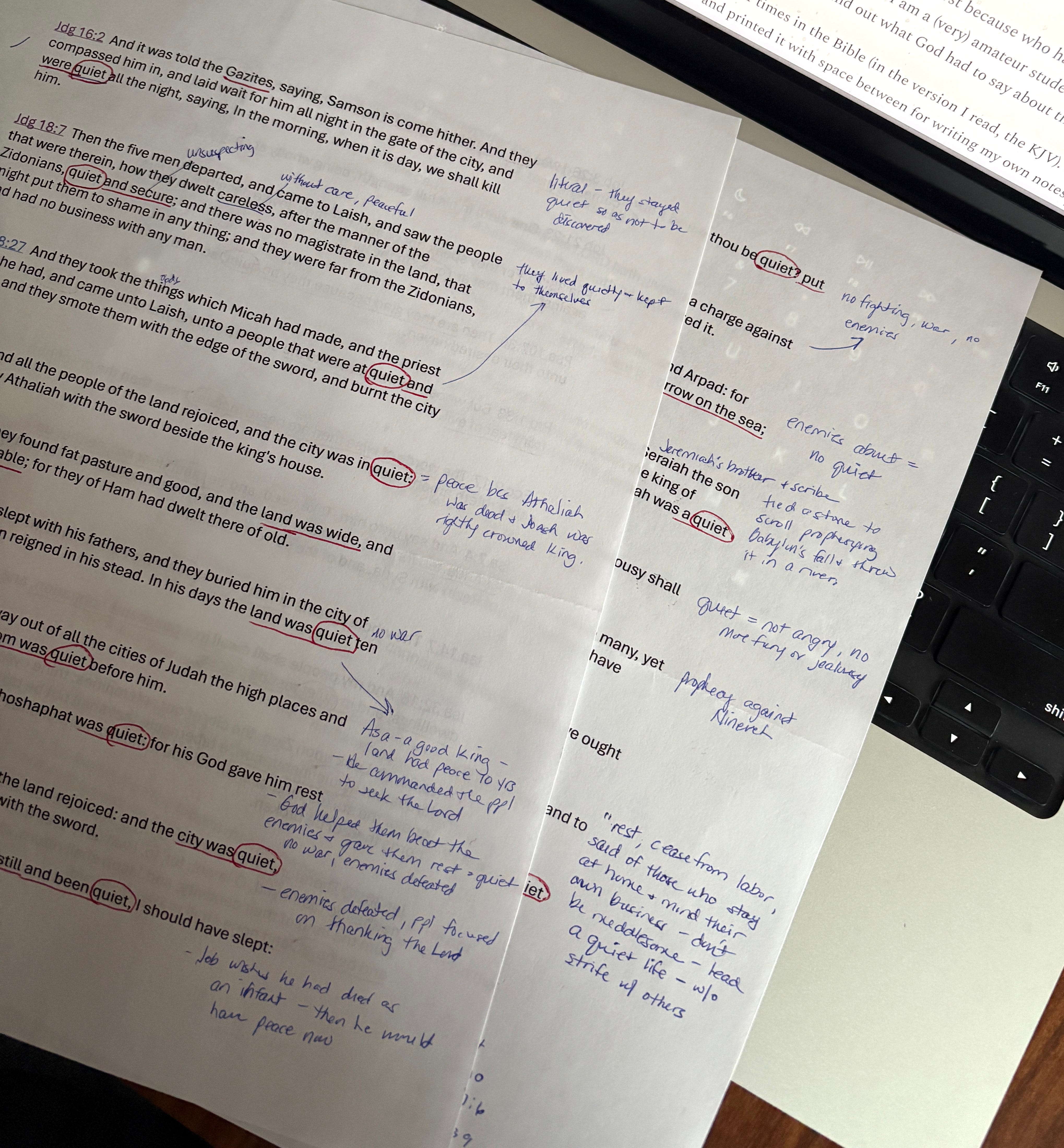
The word quiet appears 31 times in the Bible (in the version I read, the KJV). I made a list of all the verses and printed it with space between them for writing my own notes.
Here’s what I found.
In a lot of the cases, quiet refers to a land or kingdom or nation, and it speaks of the land (or kingdom) being quiet. In other words, at rest from war, peaceful, enemies defeated, no worries. Everyone can take a deep breath and stop being hypervigilant for a minute or a few years.
In 2 Kings 11, verse 20 tells us of Israel doing away with a bad ruler:
And all the people of the land rejoiced, and the city was in quiet: and they slew Athaliah with the sword beside the king’s house.
“The city was in quiet.” Turmoil and strife and worry were gone along with Athalia, who, when her son the king died, killed all his offspring so she could rule. Killed her grandchildren (all except the one the king’s sister hid from her). It didn’t take long for the captains and guards and whatnot to crown the king’s son and execute Athalia. Can you feel all the people relax?
In 2 Chronicles 20, we read about Jehoshaphat and how God helped Israel defeat their enemies. Then,
So the realm of Jehoshaphat was quiet: for his God gave him rest round about.
Same thing. The enemies were squashed and they could relax.
When I copied all these verses and saw them together, I saw a pattern. Quiet was almost always associated with rest, peace, security, lack of active enemies. When quiet reigns, people can relax. Quiet is more than just silence; it is a nervous system that is calm.
Let’s keep going.
Job uses the word quiet in his chapter-3 wish that he’d never been born. After wondering why his mother even gave birth to him, he says in verse 13,
For now should I have lain still and been quiet, I should have slept: then had I been at rest.
In this case, quiet refers to a state of peace in death: no problems, no stresses, no loss of your family and everything you own, and no body covered with sores and your wife telling you to curse God and die. His nervous system was wrecked by loss and grief and hurt. No wonder he wished for quiet.
Psalm 107:30,
Then are they glad because they be quiet; so he bringeth them unto their desired haven.
In this verse, “they” refers to waves, also known as outside circumstances or storms. People are glad when the waves of life are quiet and they can get their feet back under them.
And Proverbs 1:33,
But whoso hearkeneth unto me shall dwell safely, and shall be quiet from fear of evil.
Here, quiet is associated with safety and no fear of evil. Again, rest and peace.
Isaiah 14:7 tells us
The whole earth is at rest, and is quiet: they break forth into singing.
At this point, Israel had rest from Babylon. They were quiet: no enemy coming for them, no war. They could get a breath.
Isaiah 32:18 promises that when God’s Spirit is poured out,
… my people shall dwell in a peaceable habitation, and in sure dwellings, and in quiet resting places.
his people will dwell in a peaceful place, safe, secure.
Conversely, there is Jeremiah 49:23, which says,
Concerning Damascus. Hamath is confounded, and Arpad: for they have heard evil tidings: they are fainthearted; there is sorrow on the sea; it cannot be quiet.
The enemy is about, they’ve heard scary things, they’re afraid. “It cannot be quiet.” Not possible.
Sometimes quiet is used to describe a person. “And this Seraiah was a quiet prince” (Jeremiah 51:59), or even God himself:
So will I make my fury toward thee to rest, and my jealousy shall depart from thee, and I will be quiet, and will be no more angry. (Ezekiel 16:42)
God can choose to be quiet: not angry or jealous or furious. This one was interesting to me because we typically think the emotion of anger is not something we can help. It just springs up in us. Yet God has told us to “study to be quiet,” the opposite of anger. Obviously he wants us to work at being quiet: not angry.
Then we come to the New Testament, where quiet is used only four times.
In Acts 19, Paul was in Ephesus teaching and preaching with a few disciples, and verse 29 says “the whole city was filled with confusion.” People were angry about what he was teaching and they were all het up, as my grandmother used to say. Finally, the townclerk got everyone’s attention and said in so many words, “Look, we all know Ephesus worships the goddess Diana, and who cares if he speaks against that?”
Then he said in verse 36,
Seeing then that these things cannot be spoken against, ye ought to be quiet, and to do nothing rashly.
Quiet: calm down and think before you act. As my daughter the middle school teacher used to tell her students, “Don’t do stupid stuff.”
In 1 Timothy 2, Christians are exhorted to give thanks for and pray for those appointed over us,
For kings, and for all that are in authority; that we may lead a quiet and peaceable life in all godliness and honesty.
Quiet: a life without strife, without fear of evildoers, safe and secure. The reason we pray for authorities is because it leads to a quiet and peaceable life.
And finally, we come to 1 Peter 3, where God is addressing wives.
Likewise, ye wives, be in subjection to your own husbands; that, if any obey not the word, they also may without the word be won by the conversation of the wives;
While they behold your chaste conversation coupled with fear.
Whose adorning let it not be that outward adorning of plaiting the hair, and of wearing of gold, or of putting on of apparel;
But let it be the hidden man of the heart, in that which is not corruptible, even the ornament of a meek and quiet spirit, which is in the sight of God of great price.
In verse 1, the reason for “subjection to your own husbands” is clearly stated. It’s not because you are a second-rate citizen or you are somehow less-than. It’s so that if your husband is not a Christian, he may be won to Christ without you having to preach at him (which never endeared you to anyone). Instead, he will see your godly actions and be drawn to God because of them.
And while we’re here, let’s understand that in verse 3, God is not telling you not to braid your hair or wear jewelry or nice clothing. He is telling you that what’s in your heart—a “meek and quiet spirit”—is of much greater value than what you do to the outside of yourself. The nastiest woman can dress up and look good, but remember, God looks at the heart.
So what is a “meek and quiet spirit”?
Meek is not mousy. It does not mean being a push-over or a doormat. Moses is described as being “very meek, above all the men that were upon the face of the earth” (Numbers 12:3), and look at all he accomplished.
Meek involves having humility (not thinking of yourself more highly than you ought to think) and self-restraint (not blurting out everything you think; knowing when to keep your mouth shut). It is having patient endurance and gentleness. I’ve heard many preachers call it “power under control.”
Moses’ meekness did not prevent him from doing a lot for the Lord. Instead, he knew his own limitations and depended on God to work through him. You, wife, should do the same.
What about a “quiet spirit”?
If we look at how God uses quiet through the whole Bible, it’s easy to see God does not expect women to be silent (except for that one pesky verse in 1 Corinthians 14 we don’t like to talk about). He never says we can’t share our thoughts and opinions. He never tells us not to be leaders.
If, as we’ve seen, quiet has the idea of rest, peace, safety, security, no enemies, not angry or jealous, then we can understand the concept of a quiet spirit. In your home, does your presence induce an atmosphere of peace and rest or does it incite anger and strife? A quiet spirit should allow your family to relax, to dwell securely, to take a breath and rest.
So back to our main verse, 1 Thessalonians 4:11.
And that ye study to be quiet …
While I would love to take credit for already being good at being quiet as a natural introvert, obviously there is a lot more to it than that, and the command is not just to women. It includes men. “Ye” means all of you. All y’all.
Are people at peace in your presence? Can they rest? Do they feel safe? Can they take a breath and relax? Are their nervous systems able to be calm?
That’s quiet.
I always learn from your writing, Karen - thank you! And this tidbit, " All y’all" is a keeper! ;)
You write well and explain on a level for all to understand and give us something to think about. Thank you for sharing your talent-God has the final word.