

Someone once said “writers are readers.”
Or is it “readers are writers”?
Either way, I remember it.
Since the advent of AI, I’ve been overly conscious of making sure what I write doesn’t sound like anything else that’s out there, lest I be accused of having bots write my material. Honestly, they would make it sound better than I do, but that’s not art. The emdashes are all mine.
I often read something (I could stop at “I often read”) that makes me think of something else and I could write a whole essay about it, but I don’t want anyone to think I’m “lifting” their material. And yet, isn’t that what it means when we say “writers are readers”? We read and we are inspired to write ourselves.
I read this essay by Shannon Guerra last week, and this very thing happened.
First she said, “… my thoughts have been unpunctuated …” and I could not relate more. The daily commentary in my head is one long run-on sentence that never ends. It just morphs from one subject to the next and back and forth and round and round. I feel this sentiment deeply.
Then she said, “We’re dealing with paradox and irony, things that do go together even though they seem incongruent on the surface” and I stopped. I feel like this has been my whole life, that I’ve been living in a world where things don’t go together but they do, and the difficulty of holding two—or more—clashing thoughts at one time is too much.
Then she mentioned a loved one with dementia and I was done. Flooded with memories of the last year and two months of my parents’ lives and all they—and we—went through, doing our best but stumbling, learning a little more each day until it was too late to put all we’d learned to use.
I thought about Daddy’s forgetfulness, repeating stories that we still loved to hear, then the day I asked him a scientific question and he struggled to come up with a coherent answer. That was the day I knew I was beginning to lose him, this man who, in my mind, knew everything.
In rehab after his stroke, his bed was right next to a window that looked out on a little courtyard. There was a metal sculpture of an old-fashioned bicycle and Daddy made up a story about the man riding it, except he was serious. Then there was another story about a goose he told one of my brothers. And then, out of the blue one day when he was in the hospital for pneumonia, he told a nurse that she should pay attention to this new drug coming out of Israel and all the amazing things it did. She looked at me and asked quietly, “Is he always like this?” and I answered, “He reads a lot.”
It was true. Even in his last days he continued to read and learn new things, and while he may not have remembered all of it, some things still stuck, like the new drug.
I remembered the day (still in rehab) he insisted he wanted to shave his beard and we were all puzzled. I had not seen my daddy clean-shaven since I was a very little girl and couldn’t understand why he was so insistent, but he kept saying it to the aide who came to help him shower. He wanted to shave his beard. The aide asked for our permission and not knowing what else to say, we agreed to it.
When they came back from the shower, Daddy was clean shaven and furious. Turns out he didn’t want to shave it off, he just wanted it trimmed. He always was particular about his grooming. I felt like a failure, not understanding what he really wanted. I should have known.
After Daddy was gone two days before the new year, Mommy did well for a while. One day she was reaching down to empty a trash can and fell, injuring her right arm. That set off a series of consequences that included severe swelling in her hand and inability—or maybe there was some unwillingness—to feed herself, which led to significant weight loss and more weakness.
She had an episode that April that no one really knew what to make of, and she went from using a walker but still mostly taking care of herself to being unable to get out of a chair without the help of two people. She was mostly in a wheelchair after that except for the days she had PT, when the physical therapist was able to get her to walk down the hall and back with her walker. She said she wanted to get better, but her actions spoke a different story.
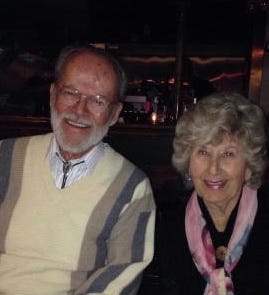
She said every day how much she missed Daddy. His ashes and picture were on her dresser and she would sit and talk to him (she told us) every day. When you’ve lived with someone for 67 years, I imagine it’s hard to feel like doing much without them.
During that time I would come to visit almost weekly from my home 3 1/2 hours away. I would walk into her little apartment at assisted living and she would always smile and say the same thing: “What are you doing here?” Sometimes we would talk for a bit and she would say it again.
Then one evening at dinner she wasn’t eating and began crying. The aides couldn’t console her and then all that came out of her were garbled sounds. People kept asking her questions and she would answer with speech that wasn’t really speech. I wondered if she could hear herself. If she knew her words weren’t actually words except for the emphatic NO when we said we wanted to take her to the hospital.
She let my sister-in-law take her jewelry off—earrings, pearls, onyx ring—right up until Phuong tried to remove Mommy’s wedding rings, and she exploded with a loud, “No, no, no, no!” and jerked her hand away.
We went to the hospital where she was given the infamous clot-busting drug. Days in ICU with other useless tests because “they” weren’t convinced it was a stroke and that made me mad. Why couldn’t it be a stroke? Because their precious drug didn’t work? Because they just can’t help themselves when someone comes in that they could do more tests on? Because they couldn’t admit that maybe sometimes God has more control than they do?
I drove up to stay with her so my brothers could go to their jobs the next day.
One night we were alone in ICU and I saw she was awake. I leaned over so she could see me and said, “Hi, Mommy” and she said ever so clearly, “I can’t talk.” I tried not to look surprised that she was speaking words and answered that I knew and that we thought she’d had a little stroke and we’d given her some medicine to help and we were just waiting for it to work. I assured her I would stay with her round the clock until it was time for us to go home. She closed her eyes and slept.
The following morning early, before light and before the busyness of the nurses’ first shift, she was awake again, so I went and did my usual. I leaned over her and said, “Hi, Mommy.” She studied me for a moment and finally said, “It’s too late.”
I smiled and said I was still going to stay with her and we would be transferred to a regular room sometime that day, and then we’d go home.
We got to the regular room and the sweetest nurse came in to bathe her, now almost completely unconscious. She was so kind and gentle and caring as she dabbed a little lotion on the dry skin on Mommy’s face, saying, “I always feel better when my skin is moisturized.”
Sometimes it’s hard to realize that Mommy’s last words to me were “I can’t talk” and “It’s too late.” Did she know? Maybe she knew. I didn’t want to know.
I try not to dwell on the difficulties of the last year or so of my parents’ lives, but those are the things that are so clear in my memory. Of course I remember a lifetime of happy things, but the end is right here, always in the forefront.
We go through life thinking everything is fine, and then suddenly and with finality, it is not. The end happens so quickly, even when it’s a year and two months. You live the whirlwind of every day being a new issue to address and making the best decisions you know how and the phone always dinging with a new message in the family text thread.
Watching my brothers and me go through this was enough to convince one of my nieces to have at least two children so they would have someone to help them through this same experience when their own parents were failing.
And maybe that’s the hardest part—to admit that your parents are failing, these people who have always been a constant in your life, a given. Until they’re not.
There is no point to this essay, article, post—whatever we’re calling them now. It just surprised me how reading someone else’s word—dementia—brought this all up yet again, perfectly clear memories like they happened yesterday, and I thought it would be a good time to give my own words somewhere to live outside of me.
I love you, Mommy and Daddy. Miss you every day.
I know it must feel better saying all you words out loud on paper. Thank you for sharing your burdens and memories Diana
Thank you so much for linking to my article. I'm so grateful it spoke to you; I found so much encouragement and...well, "seen-ness" in reading this post of yours, too. Thanks so much for letting us see part of how you processed this.